1. Manufacturing process of tool bags
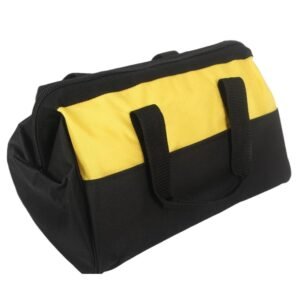
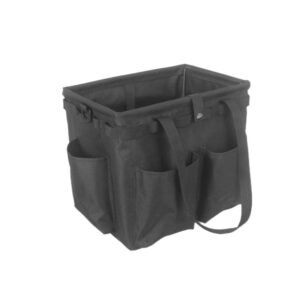
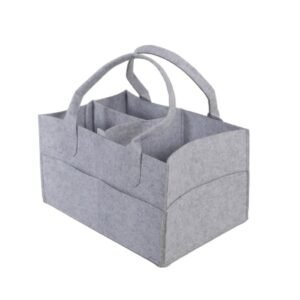
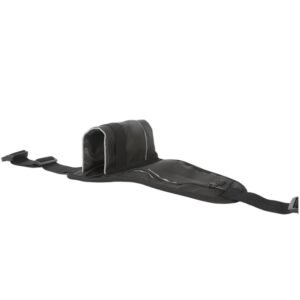
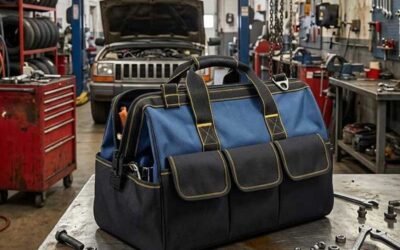
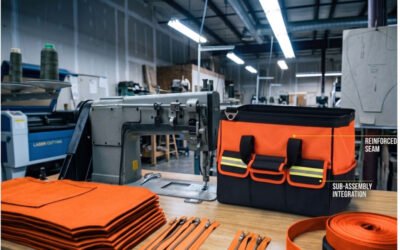
The standard manufacturing process of tool bags is a structured, multi-step workflow designed to create a durable, functional product capable of carrying heavy loads and withstanding harsh conditions. The process ranges from initial design and material selection to cutting, sewing assembly, and rigorous quality control.
Here is a detailed breakdown of the standard phases in the manufacturing process of tool bags:
1.1. Design and Development
Before production begins, a precise blueprint of the tool bag is created.
- Conceptualization: Designers determine the bag’s intended use, capacity, number and types of pockets, and ergonomic features like handles and straps.
- CAD Drawings: Using Computer-Aided Design (CAD) software, technical specialists create detailed 2D or 3D drawings. These specify exact dimensions, pattern pieces, seam allowances, and placement of components like zippers, hardware, and logos.
- Prototyping: A first-article sample (prototype) is hand-built based on the CAD design. This prototype is tested for fit, function, and durablity. Adjustments are made to the design and patterns before full-scale production is approved.
1.2. Material Selection and Preparation
The durability of a tool bag is directly tied to the materials chosen.
Fabric Selection: Manufacturers choose heavy-duty fabrics based on the bag’s specifications.
- Canvas: A classic choice, often preferred for its ruggedness. Heavyweight “duck” canvas or waxed canvas (for water resistance) is common.
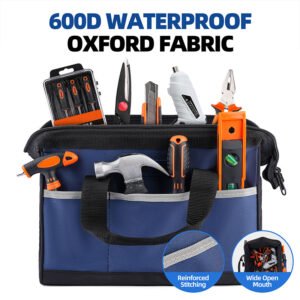
- Polyester: Known for being affordable and durable. Specific types like 600D (Denier) or Oxford polyester are popular.
- Nylon: Offers a high strength-to-weight ratio and excellent abrasion resistance. Ballistic nylon or premium brands like Cordura are used for top-tier bags.
- Leather: Used for traditional, extremely robust bags, though it is heavier and more expensive than synthetics.
Hardware and Components: Sourcing of high-quality, durable components is critical.
- Zippers: Heavy-duty, oversized metal or nylon coil zippers.
- Thread: Industrial-strength, bonded nylon or polyester thread.
- Webbing: High-tensile strength polypropylene or nylon webbing for handles and shoulder straps.
- Hard Bottoms: Injection-molded plastic (e.g., polypropylene) bases are frequently added to provide structural rigidity and waterproof protection from the ground.
Preparation: Fabrics may be pre-treated with water-resistant or UV-resistant coatings.
1.3. Cutting
Once patterns are finalized and materials are on-site, the bulk fabric is cut into individual components.
Spreading: Multiple layers of fabric are spread evenly on long cutting tables.
Template Placement: Physical templates or markers derived from CAD files are placed on the fabric to maximize material usage and reduce waste.
Cutting Techniques:
- Manual Cutting: Use of electric rotary cutters or band knives for smaller batches or complex shapes.
- Die Cutting: Large hydraulic presses use metal dies (like cookie cutters) to punch out shape components rapidly and accurately.
- CNC/Laser Cutting: Automated, computer-controlled tables use mechanical blades or lasers for extremely precise, high-speed cutting of multilayer stacks.
1.4. Branding (Optional)
If the bags are to be customized with a logo, this step usually occurs after cutting but before final assembly to allow flat access to the panels.
- Screen Printing: Most cost-effective for large batches and simple designs.
- Embroidery: High-quality, durable method for rendering complex logos.
- Heat Transfer: Used for full-color or photographic designs.
1.5. Assembly and Sewing
This is the most labor-intensive stage, where the individual pieces are transformed into the finished bag.
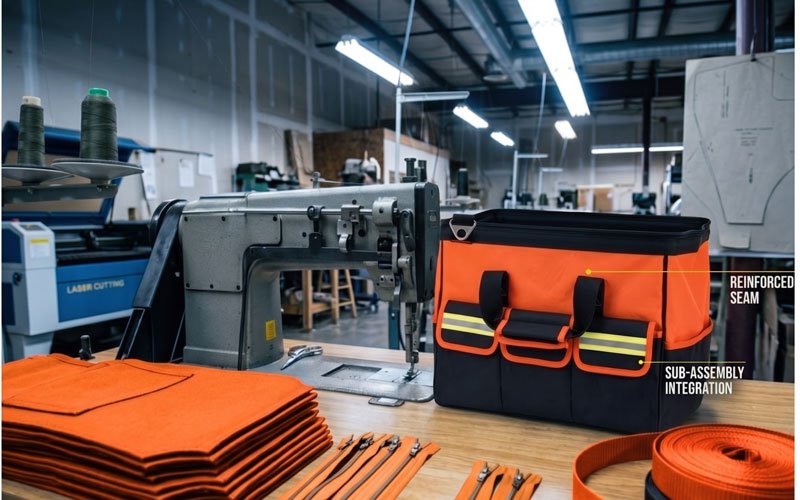
Sub-Assembly: Internal and external pockets, compartments, and tool loops are sewn onto the main body panels first.
Stitching Techniques:
Double Stitching & Bar-Tacking: High-stress areas such as handle attachments, strap anchor points, and pocket corners are reinforced with extra rows of stitching or dense bar-tack stitches.
Piping/Binding: Fabric or plastic trim is often sewn over raw seams to hide them, reduce fraying, and add structural stiffness.
Main Assembly: The front, back, bottom, and side panels are joined together to form the main bag body.
Component Integration: Zippers are installed, handles and shoulder straps are attached, and any internal dividers are secured.
Hard Base Attachment: If applicable, the fabric body is secured to the hard injection-molded base, often through riveting or heavy-duty sewing.
1.6. Quality Control (QC)
Quality control is an ongoing process with checks at every stage, but it is formalized into three primary phases.
Incoming Material Inspection (IQC):
Before production, raw materials (fabric, zippers, hardware, thread) are inspected for color consistency, tensile strength, and defects to ensure they meet specifications.
In-Process Quality Control (IPQC):
During production, random samples are taken from the assembly line. Inspectors check for correct seam allowances, proper stitch density, adequate reinforcement in load-bearing areas, and functional operation of sub-assemblies like pockets.
Final Quality Inspection (FQC):
Every finished bag (or a statistical sample) undergoes a comprehensive final check.
Visual Check: Inspecting for loose threads, skipped stitches, blemishes, or misalignment.
Functionality Test: Testing all zippers, buckles, and compartments for smooth operation.
Performance Testing: Specific stress tests may be performed, including:
- Pull Test: Checking the strength of handles and straps under load.
- Drop Test: Verifying that a fully loaded bag can withstand falling without rupture.
- Water Resistance Test: For specified waterproof bags, checking for seam leakage.
1.7. Packaging and Shipping
After passing final inspection, the bags are prepared for distribution.
- Cleaning: Any remaining threads are trimmed, and dust is removed.
- Tagging: Attaching hangtags, user manuals, or warranties.
- Packing: Bags are folded (if possible) or stuffed to maintain shape, placed in polybags, and then packed into master cartons for shipment to distribution centers or retailers.
2. Key Manufacturing Challenges and Targeted Solutions
During the mass production of tool bags, small and medium-sized manufacturers frequently encounter issues such as inconsistent fabric coating quality, insufficient structural durability, and batch-to-batch quality variations, leading to high defect rates and customer complaints.
Key production challenges and optimized solutions are summarized in Table.
| Manufacturing Challenges | Specific Performance Problems | Optimized Solutions |
| Uneven functional coating quality | TPU/PU coating is uneven, low peeling strength, easy to foam and peel after long-term use; poor waterproof and oil-proof stability | Introduce precision constant-temperature coating equipment, strictly control the hot pressing temperature at 160-180℃ and tension parameters; conduct sampling peeling strength test for each batch of coated fabrics to ensure the strength ≥4N/mm |
| Insufficient structural durability | Handle detachment, pocket corner cracking, bottom sagging; thread breakage under heavy load; easy deformation after extrusion | Adopt integral through-bottom webbing structure and box-X reinforced stitching; add PE rigid support board and wear-resistant patches at stress parts; use steel rivets for auxiliary reinforcement at the bottom |
| Unstable batch quality consistency | Different fabric color density, inconsistent stitching density, uneven accessory assembly position among different batches | Implement batch raw material management system, inspect all materials before production; unify machine parameter settings and operation standards; arrange special personnel for batch sampling inspection |
| Low production efficiency of customized products | Personalized size, logo and structural customization lead to prolonged production cycle and increased error rate | Establish modular customization templates; split personalized processes independently; arrange professional customized production lines to improve processing accuracy and efficiency |
3. Common Problems for Purchasers, Wholesalers and Customizers
In the tool bag industry chain, purchasers, wholesalers and customizers face different pain points in procurement, sales and customization links. These problems are mainly caused by information asymmetry, inconsistent industry standards and irregular production processes, which affect product sales and user experience.
3.1 Common Problems for Purchasers
First, it is difficult to identify product quality differences. Many purchasers cannot distinguish the density of Oxford cloth, coating thickness and stitching standards, and easily buy low-cost inferior products with poor wear resistance and low load-bearing capacity.
Second, the actual functional effect is inconsistent with the publicity. Many ordinary fabric tool bags are falsely advertised as waterproof and oil-proof, failing to meet the needs of harsh working environments.
Third, the after-sales guarantee is imperfect. Some manufacturers refuse to bear the responsibility for product cracking and coating peeling within the warranty period, increasing the use cost of purchasers.
3.2 Common Problems for Wholesalers
Wholesalers mainly face inventory and market adaptation problems. On the one hand, the product homogeneity is serious. Most manufacturers have single product styles, which cannot meet the differentiated market needs of high-end industrial use and daily civilian use, resulting in sluggish sales.
On the other hand, batch quality fluctuation is obvious. The quality of goods supplied by manufacturers in different batches is unstable, leading to inconsistent product reputation and affecting long-term customer cooperation.
In addition, the delivery cycle is unstable, and seasonal order surges easily cause delayed delivery, resulting in customer loss.
3.3 Common Problems for Customizers
Customized customers (enterprise group purchase, brand customization) often face three major problems.
First, the customization threshold is high. Many small manufacturers have high minimum order quantity requirements, which is not friendly for small-batch personalized customization.
Second, the customization accuracy is insufficient. Problems such as blurred logo printing, inconsistent custom size deviation and unreasonable personalized pocket structure often occur.
Third, the cost transparency is low. Some manufacturers charge hidden fees for plate making, proofing and process modification, resulting in excessive customization costs.
In addition, the customized product proofing cycle is long, which cannot meet the urgent order demand of customers.
4. Industry Optimization Suggestions
For manufacturers, it is necessary to upgrade production equipment, unify process standards, and strengthen raw material inspection and finished product testing to improve batch quality stability.
For wholesalers and purchasers, it is necessary to establish a complete supplier evaluation system, prioritize manufacturers with standardized processes and perfect quality inspection, and clarify functional parameters and after-sales terms in procurement contracts.
For customizers, it is recommended to confirm design drawings, size parameters and process standards in advance, and choose manufacturers with independent proofing capabilities and transparent charging standards to avoid customization risks.
5. Conclusion
Tool bag manufacturing is a complex process that balances material performance, structural design, and precision engineering. As industrial applications continue to evolve, the market increasingly demands greater durability, functionality, and personalization.
By standardizing the entire production lifecycle, resolving core quality issues, and streamlining procurement and customization services, manufacturers can significantly elevate product quality. Ultimately, this approach reduces collaboration risks across the supply chain and drives the industry toward standardized, high-quality development.